Burrito Bison: Launcha Libre
- 4.8
- Rating
- 10.00M
- Installs
- Free
- Price

 Analysis by App-foxy
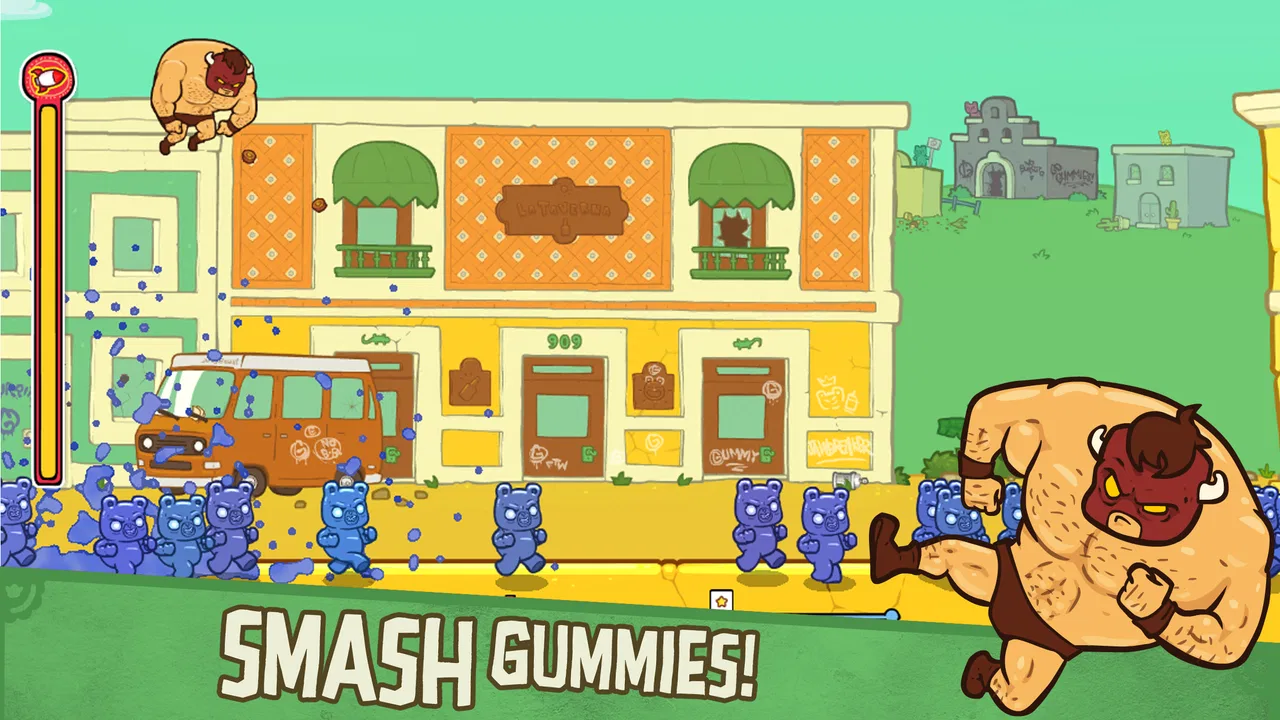
Burrito Bison: Launcha Libre is the kind of arcade game I open when I want immediate action rather than a long tutorial or a complicated control scheme. I launch a character, try to keep the run alive, react quickly, and chase a better result. That simple loop is easy to understand, but the candy-themed setting gives it more personality than a basic score-chasing game. I found it especially comfortable for short sessions, although it also has enough progression pressure to encourage repeated attempts.
Developed by Kongregate, this free arcade game puts Burrito Bison in a battle against the forces of candy. The premise is deliberately silly, and that helps the game avoid feeling too serious when a run ends because of one mistimed decision. Its audience is broad: the content rating is Everyone, the minimum operating system is 8.0, and the game is available without an upfront purchase. That makes it easy to try, but the presence of optional purchases means I would still approach the economy with a little attention rather than assuming every player will experience it in exactly the same way.
How the launch loop feels after the first few sessions
The first thing I noticed is how quickly the game communicates its main idea. You do not need to study a complex ruleset before understanding that a strong launch, good timing, and smart reactions can turn one attempt into a much better run. This is a useful design choice for mobile play because I can pick it up during a short break and start playing almost immediately.
You May Also Like

 Blood Strike: 2.5 Anniversary
Blood Strike’s Loadouts Turn Every Drop Into a Tactical Gamble
A close look at Blood Strike’s custom loadouts: how fast access to signature weapons reshapes its battle royale rhythm, rewards preparation, and narrows the gap between fights.

 Pandora - Music & Podcasts
Pandora’s Music Is Easy to Start, but Harder to Recover
Pandora’s strength is its low-effort path from a seed to a station. Its weak spot is how much confidence it asks you to place in connection, setup, and quiet recovery.

 8 Ball Pool
 Is Built on Rivalries, Rematches, and Routine
A close look at the rivalries, rematches, shared routines, and unanswered safety questions that turn a quick pool match into a persistent mobile community.

 Samsung Music
’s Quiet Strength Is Playing What You Already Own
Its reach comes less from spectacle than from dependable access to a personal library. That simplicity is both the app’s strongest retention engine and its ceiling.

 AccuWeather: Weather Radar
AccuWeather Review: A Quick, Clear Forecast for Everyday Decisions
For everyday plans, the best forecast is the one you can understand quickly. AccuWeather makes rain timing, radar, and local conditions easy to act on, with a few trade-offs.

 Hill Climb Racing
Why Hill Climb Racing Still Turns Crashes Into One More Run
A tiny car, a bumpy hill and one more upgrade: Hill Climb Racing keeps resurfacing because its simple chaos makes every near-miss feel personal.
More From Our News Desk



The arcade structure also makes failure feel less final than it would in a traditional level-based game. A failed attempt is not simply wasted time; it gives me a reason to adjust my next launch, watch the action more carefully, and try to extend the run. That repeated loop is the main appeal. If you enjoy improving through small corrections, the game has a satisfying rhythm. If you prefer a clear campaign with a definite ending, the open-ended chase for better performance may feel less rewarding.
My best advice for new players is not to treat every launch as a frantic race. The early part of an attempt is a chance to establish control and notice how the action is developing. Pressing or reacting without a plan can make a run feel random, while waiting for a more useful moment often produces a cleaner result. That is one of the first non-obvious lessons here: the game looks chaotic, but patient observation matters more than constant tapping.
The candy setting is more than a visual joke. It gives the hazards and opponents a consistent identity, so the action feels like a playful world rather than a collection of unrelated obstacles. Burrito Bison’s exaggerated character design also makes mistakes easier to accept. I can laugh at a bad attempt and restart instead of feeling that the game has punished me unfairly, even when I know the mistake was mine.
Progress is motivating, but it can also create pressure
Repeated attempts become more meaningful because the game encourages gradual progress. I usually approach this kind of arcade title with a small target: survive a little longer, improve one part of the run, or reach a point that previously seemed difficult. That method works well here because it turns short sessions into a series of manageable goals. It is more satisfying than trying to achieve a perfect result immediately.
There is a trade-off, though. The same progression pressure that keeps me returning can make the game feel repetitive if I am not in the mood to repeat a launch cycle. Players who enjoy optimization will likely appreciate that tension. Players who want constant novelty may eventually feel that they are revisiting the same basic idea with increasingly demanding expectations.
A practical routine helps. I prefer playing several focused attempts instead of continuing indefinitely after my concentration drops. Once I begin making rushed choices, another run often teaches me less than taking a short pause. This is particularly useful on a phone, where a game can easily become a background habit. The title works best when I use its short-session nature deliberately rather than letting the progression system dictate how long I play.
Another useful approach is to separate experimentation from improvement. In one attempt, I may deliberately try a different timing choice simply to understand the result. In the next, I return to the approach that has worked most consistently. That prevents every failure from feeling like a setback. It also makes the arcade loop more analytical: I am not only hoping for a lucky run; I am learning which decisions give me better control.
Spending, fairness, and what a free download really means
The game is free to download, while its listed in-app purchases range from $0.99 to $29.99 per item. That is the important purchase context for anyone deciding whether it belongs on a family device or a personal phone. I would not describe the presence of purchases as a reason to avoid the game outright, but I would not ignore them either. A free entry point can be convenient, while optional spending can change how comfortable the progression feels for different players.
From a fairness perspective, I judge the experience by whether my decisions still matter when I refuse to spend. Burrito Bison works best for me when I treat each attempt as a test of timing and persistence rather than as something I should accelerate with money. That mindset keeps the arcade challenge intact. If you are highly sensitive to any purchase prompts or dislike progression systems that may encourage spending, this is not the right kind of free game for you.
I also would not recommend buying anything simply because a run went badly. A poor attempt is often a sign that I was rushing, not proof that I need an upgrade or a shortcut. Waiting until I understand the basic rhythm gives me a better basis for deciding whether optional spending adds enjoyment. This is a practical fairness check: first establish whether the core loop is fun on its own, then consider whether a purchase genuinely improves your experience.
The available purchase range tells me that spending can be modest or considerably higher depending on the item selected, but it does not by itself explain how every purchase affects play. I therefore avoid treating purchases as mandatory or harmless in every situation. Parents should use the device’s purchase controls, and players who want a strictly no-spend arcade experience should decide that boundary before starting rather than after becoming invested in progress.
What I can say with confidence is that the game’s strongest appeal does not depend on a complicated spending strategy. The fun comes from launching, reacting, and trying to improve. That is good news for players who want a quick arcade distraction, but it also means the value of any purchase depends heavily on personal patience. Someone who enjoys replaying attempts may have little reason to spend, while someone who dislikes repetition may be more tempted to look for a faster route.
Is it competitive, or mainly a personal challenge?
I see Burrito Bison primarily as a personal arcade challenge. The meaningful competition is usually with my previous performance: can I make a cleaner attempt, respond more consistently, and avoid the mistake that ended the last run? That focus makes the game approachable because I do not need to be an expert before enjoying it.
It also affects how I think about fairness. A personal score chase feels fair when I understand that improvement comes from practice and better decisions. The game’s playful presentation supports that attitude, but the pressure of progression can still make losses feel frustrating. The healthiest way to play is to measure progress in small steps instead of expecting every session to produce a dramatic breakthrough.
Compared with slower puzzle games, this is more immediate and reflex-oriented. Compared with traditional platform games, it offers less emphasis on exploring a carefully designed space and more emphasis on maintaining momentum through a repeated launch sequence. Compared with endless runners, it has a more distinctive character and setting, but it still asks for the same kind of quick attention: watch what is happening, react at the right moment, and try again when the attempt ends.
That comparison also shows who should skip it. If you want deep strategy, long narrative scenes, or a calm game that can be played without reacting quickly, another category will suit you better. If you enjoy arcade loops but dislike replaying similar attempts, the novelty may wear off. On the other hand, if you want a game that can fill a few spare minutes and still offer a reason to return, this is a strong match.
For an everyday example, I can imagine playing it while waiting for a coffee or during a short commute break. I would not need to prepare a large mental map or remember a complicated control layout. I could play a few attempts, stop when my attention is needed elsewhere, and return later with the same basic objective. That convenience is one of the title’s real strengths, although anyone prone to “one more try” sessions should set a stopping point before starting.
Details worth knowing before you install
The game has an average rating of 4.8 from around 673 thousand ratings, with more than 46 thousand written reviews. It has also passed 10 million installs. Those figures suggest that the format has reached a large audience, but popularity should not replace personal judgment. A highly rated arcade game can still be a poor fit if you dislike repetition, fast reactions, or optional purchases.
The current version is 3.75, and the game was released on November 8, 2016. That history matters because this is not a brand-new experiment trying to explain its identity from scratch. It has had time to establish its particular style and loop. For me, that makes it easier to recommend to someone who wants a recognizable arcade experience rather than a complicated new system to learn.
One question many players have is whether the game is suitable for younger users. Its Everyone content rating makes it broadly accessible in terms of age classification. I would still keep the purchase settings in mind on a shared device, because age suitability and spending control are separate issues. The playful tone is approachable, but adults should decide what purchase access is appropriate for the person using the phone.
Another question is whether it is worth trying if I only play occasionally. I think so, provided you enjoy short, repeatable challenges. The controls and objective are easy to revisit, which is useful when I have not played for several days. The downside is that occasional players may feel less connected to the progression pressure than dedicated players. If you only want a quick distraction, ignore the urge to optimize every run and treat the game as a compact arcade toy.
Players also often wonder whether a free game can remain enjoyable without spending. My answer is cautious but positive: the core appeal is understandable without paying, and I can enjoy the launch-and-retry rhythm as a no-spend player. Still, the purchase range means I would make a personal rule before playing. If you are comfortable with optional purchases and can keep them intentional, the free download is an easy way to test the fit. If any monetization pressure ruins the experience for you, choose a paid arcade game with a simpler purchase model instead.
My trust verdict after weighing the trade-offs
The best reason to play Burrito Bison: Launcha Libre is the clarity of its arcade loop. I always know what I am trying to do, yet the timing and repeated attempts leave room for improvement. The candy-world presentation keeps the mood light, and the character gives the game a memorable identity instead of making it feel like a generic reaction test.
I would recommend it to players who like quick sessions, playful action, and personal score chasing. It is particularly suitable for someone who wants a game that can be understood quickly but still rewards attention over time. The free price makes trying it easy, while the Everyone rating and minimum operating system of 8.0 make it accessible across a wide range of compatible users and devices.
I would be more selective with players who dislike repetition or who want complete certainty that no spending pressure will appear in a free game. The in-app purchase range is from $0.99 to $29.99 per item, so I would not hand the phone to a child without checking the device’s purchase controls. I also would not recommend it as a substitute for a deeper strategy game or a story-driven adventure; its strengths are narrower and more focused.
In my experience, the fairest way to approach it is to enjoy the challenge first and consider spending only if it clearly adds to that enjoyment. Do not let a frustrating attempt make the decision for you. Play enough to learn the rhythm, set a session limit, and decide whether the repeated launch loop remains fun without assistance.
Overall, Burrito Bison: Launcha Libre earns my recommendation as a lively, accessible arcade game with a strong short-session identity. It is not perfect for every player, and the purchase options deserve sensible boundaries, but the central challenge is easy to enjoy on its own terms. If you want a colorful game that turns a few spare minutes into a small personal contest, I think it is worth installing and judging through several honest attempts rather than through its free label alone.
FAQs for Burrito Bison: Launcha Libre
01What is the main objective of Burrito Bison: Launcha Libre?
Burrito Bison: Launcha Libre is a fun and addictive game where players help the titular character launch himself as far as possible through a colorful world filled with gummy bears and obstacles. The goal is to travel the furthest distance, collecting coins and achieving various objectives along the way to unlock upgrades and power-ups.
02How do the in-game purchases work in Burrito Bison: Launcha Libre?
The game offers in-game purchases that allow players to buy coins or special packs to enhance their gameplay. These purchases can be used to unlock upgrades quicker, buy power-ups, or access special features. While the game is free-to-play, these optional purchases can enhance the experience for those who wish to progress faster.
03What platforms is Burrito Bison: Launcha Libre available on?
Burrito Bison: Launcha Libre is available for download on both Android and iOS platforms. Players can find the game on the Google Play Store for Android devices and the Apple App Store for iOS devices. The game is designed to run smoothly on most smartphones and tablets.
04Are there any ads in Burrito Bison: Launcha Libre?
Yes, Burrito Bison: Launcha Libre does contain ads. These ads can appear between levels or when opting to watch an ad for additional rewards. While they are part of the game’s free-to-play model, players can choose to remove ads through an in-app purchase, providing an uninterrupted gaming experience.
05Is Burrito Bison: Launcha Libre suitable for children?
Burrito Bison: Launcha Libre is generally suitable for children, offering a fun and colorful environment with simple mechanics. However, parents should be aware of the in-game ads and optional purchases. It’s always a good idea to supervise younger players to ensure a safe and controlled gaming experience.
Pros
- Engaging and addictive gameplay.
- Colorful and vibrant graphics.
- Humorous storyline and characters.
- Simple controls for easy play.
- Frequent updates with new content.
Cons
- Can feel repetitive over time.
- In-app purchases can be pricey.
- Requires internet for full features.
- Ads can interrupt gameplay.
- Progress can be slow without purchases.

Burrito Bison: Launcha Libre
Gallery